
Every marketing team that works with video eventually hits the same wall. The demand for short clips keeps growing, but the editing workload grows even faster. What once felt manageable with manual editing becomes expensive, slow, and difficult to scale. This is where ROI becomes the real decision factor.
This article breaks down the return on investment of manual video editing compared to AI clip makers. It focuses on real costs, time trade-offs, team efficiency, and content output, with a clear lens on how platforms like LiveLink AI fit into modern workflows.
Why ROI matters more than editing preference
Many teams choose editing methods based on comfort or habit rather than numbers. ROI forces a more practical conversation.
ROI in video clipping is influenced by:
- Time spent per clip
- Cost of labor
- Volume of clips produced
- Speed to publish
- Consistency across platforms
When output expectations rise, manual workflows often struggle to keep up.
Understanding manual video editing workflows
Manual editing usually involves traditional video editing tools and human-driven processes.
Typical steps include:
- Reviewing long videos
- Marking timestamps
- Cutting clips
- Framing for vertical formats
- Adding captions
- Exporting multiple versions
Each step requires attention and repetition.
Time investment per clip
On average, manual clipping can take 30 to 90 minutes per short clip depending on complexity.
For teams publishing daily, this quickly compounds.
Cost structure of manual editing
Manual editing costs are often underestimated.
They include:
- Editor salaries or freelance rates
- Revision cycles
- Project management time
- Opportunity cost of slower publishing
What AI clip makers actually do
AI clip makers automate the repetitive parts of video clipping.
They use models to:
- Detect engaging moments
- Track speakers automatically
- Format videos for vertical platforms
- Generate captions
- Apply brand templates at scale
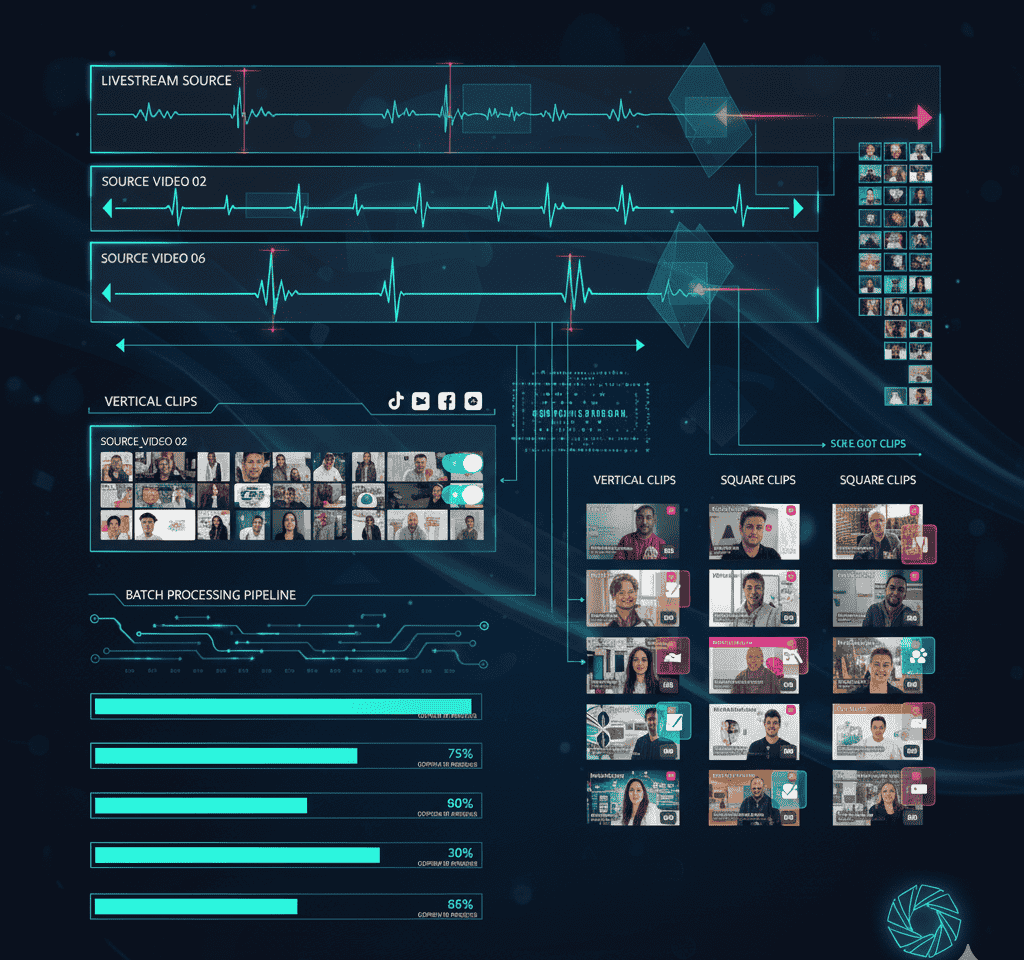
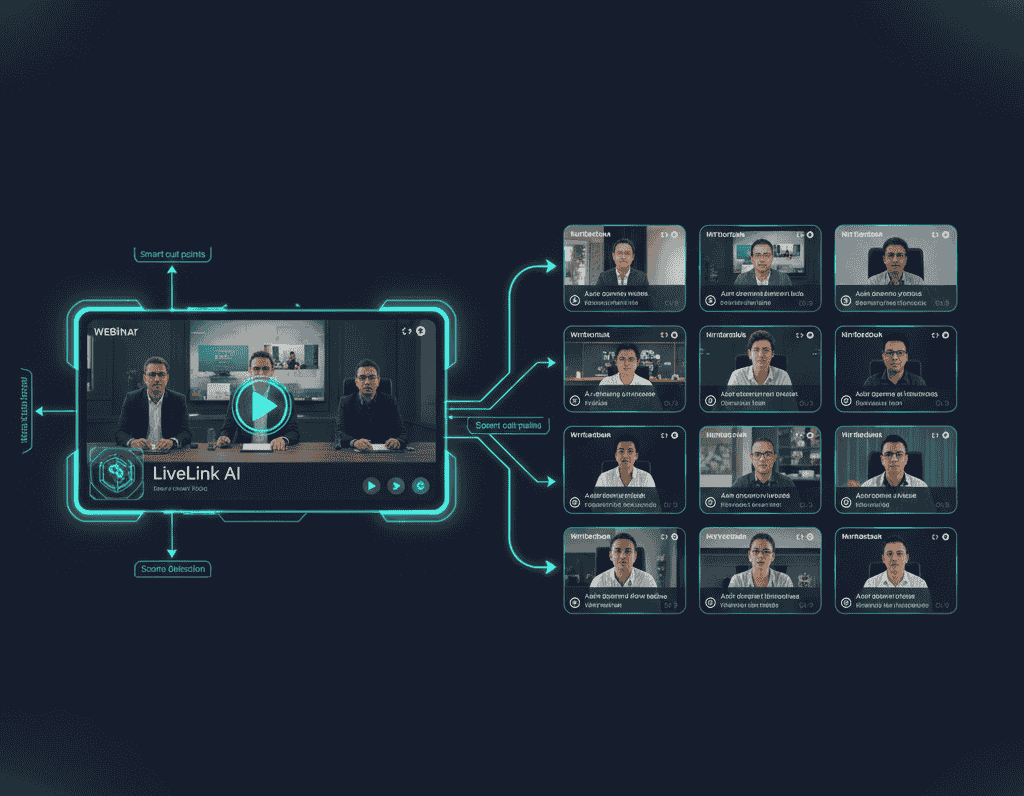
LiveLink AI focuses on turning long-form content into multiple ready-to-post clips in minutes.
Time comparison manual vs AI
Manual editing timeline
- Review content: 20 to 40 minutes
- Clip selection: 10 to 20 minutes
- Editing and formatting: 20 to 30 minutes
- Captions and exports: 10 to 15 minutes
Total per clip: 60 to 105 minutes
AI clip maker timeline
- Upload video: 2 to 5 minutes
- Automated clip generation: minutes
- Review and approve: 5 to 10 minutes
Total per clip: 10 to 20 minutes
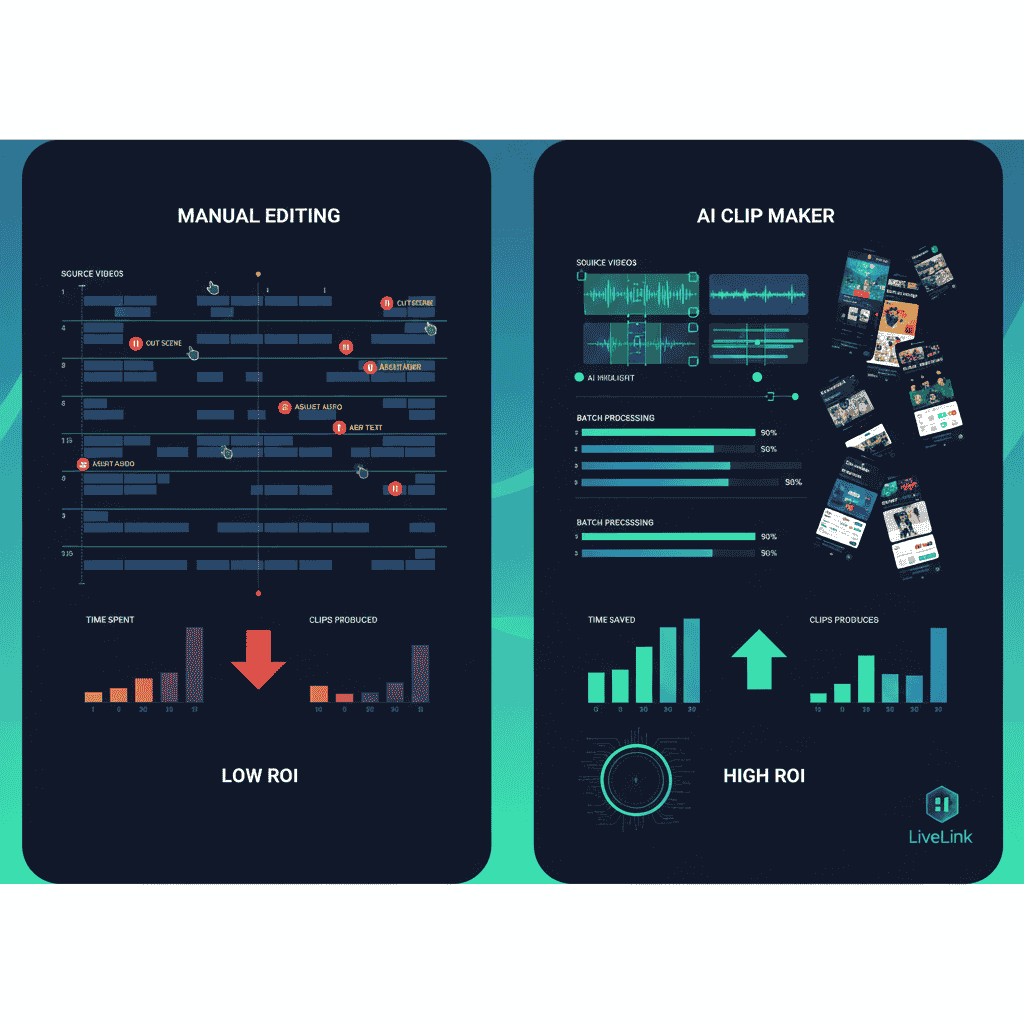
The time savings alone create a strong ROI argument.
Cost comparison in real numbers
Manual editing example
Assume:
- Editor cost: $25 per hour
- Clips per week: 30
- Average time per clip: 60 minutes
Weekly cost: $750 Monthly cost: $3,000
AI clip maker example
Assume:
- LiveLink AI subscription
- Same clip volume
- Minimal human review time
Monthly cost remains fixed while output increases.
Scale and volume impact on ROI
Manual editing scales linearly. More clips require more time and people.
AI clip makers scale non-linearly. One upload can produce many clips without additional labor.
This difference becomes critical for:
- Agencies managing multiple clients
- SaaS teams publishing weekly content
- Podcasters and educators
Consistency and brand ROI
Manual editing introduces variability.
AI-based workflows maintain consistent:
- Framing
- Captions
- Branding
- Formatting
Consistency improves recognition and reduces rework.
Speed to publish and performance ROI
Faster publishing increases the chance of relevance.
AI clip makers allow:
- Same-day clipping
- Faster response to trends
- Regular posting schedules
Delays in manual editing often result in missed opportunities.
Revision cycles and hidden costs
Manual editing often requires multiple revisions.
AI clip makers reduce revisions by:
- Standardized templates
- Predictable outputs
- Clear preview before export
This lowers communication overhead.
Quality comparison manual vs AI
Manual editing allows creative flexibility.
AI clip makers focus on efficiency and consistency.
The best workflows combine both, using AI for volume and humans for high-impact edits.
Where LiveLink AI changes the ROI equation
LiveLink AI is designed for scale.
It supports:
- Bulk clip creation
- Speaker tracking
- Auto captions
- Branded templates
- Multi-platform formatting
This reduces both cost per clip and time to publish.
Real world use cases
Agencies
Agencies reduce cost per client while increasing output.
Content teams
Internal teams publish more without expanding headcount.
Educators and creators
One long video becomes weeks of content.
Measuring ROI properly
Track metrics that reflect efficiency and output.
- Cost per clip
- Clips published per week
- Time to first post
- Engagement consistency
Common mistakes when calculating ROI
- Ignoring revision time
- Overlooking opportunity cost
- Comparing tools without volume context
FAQs
Is AI editing replacing editors
No, it reduces repetitive work.
Is manual editing still needed
Yes, for complex or cinematic edits.
Can AI clips perform as well
Yes, consistency often improves performance.
Does LiveLink AI reduce editing costs
Yes, by lowering time and labor requirements.
How fast can teams see ROI
Often within the first month of use.
Final takeaway
Manual editing offers control but struggles at scale. AI clip makers deliver speed, consistency, and predictable costs. When ROI is measured honestly, AI-driven workflows consistently outperform manual processes for short-form content production.
LiveLink AI fits into this model by helping teams produce more clips with less effort, making video content sustainable and profitable over time.